
The Monorail Moment
Every so often, we get swept up in a miracle — a gleaming idea that promises to solve everything at once: faster, cheaper, smarter. Build Canada Homes is convinced that factory-built housing is the answer to solving both quantity and affordability at a national level. That has me encouraged and puzzled. Whenever life gives me tough questions, I look to a source of ageless wisdom: The Simpsons.
In Springfield, a man named Lyle Lanley convinced an entire town that their future ran on elevated tracks. There were plenty of doubters, but enthusiasm drowned them out. And to be fair, the monorail wasn’t a bad idea — it just wasn’t ready for Springfield. The same concept works beautifully elsewhere; Vancouver’s SkyTrain proves that in the right context, with the right systems, an ambitious idea can transform a city. For Springfield, it was a monorail. In Canada, it might be modular housing. Both came with catchy headlines and confident frontmen promising that change could be achieved through one grand, sweeping move.

That’s how I feel about the federal policy around modular housing. I genuinely believe it can deliver better-quality spaces, faster and more affordably than we’re used to as Canadians. I believe in it so much that I’ve invested my own money where my convictions lie. Nevertheless, I want that same enthusiasm for a better future to be channelled into the right areas. Canada’s modular industry is still young and fragile; it needs support before it can shoulder the weight of national expectations. We do need modular to help improve housing stock and affordability quickly — but that success will come from investing in factories, in innovation, and in the systems that make consistency possible. There are no overnight miracles. There are grand gestures and good fundamentals — and only one of those delivers results.
The government’s $13-billion announcement shows genuine ambition, but enthusiasm alone can’t replace structure. Buying factories without changing the habits of how we build is like buying a treadmill to get in shape: the tool helps only if there’s a routine to go with it. What Canada needs isn’t just modular factories; it’s modular discipline — steady project pipelines, repeatable design templates, and public-private alignment that turns construction into cadence. Factories thrive on rhythm. When production flows predictably, efficiency compounds, costs stabilize, and innovation follows.

I’ve been thinking about modular construction for nearly fifteen years — long before it became a political talking point. My curiosity began with a simple question: why does housing go together so inefficiently? As a design-builder, I’ve spent years negotiating volatile pricing and watching homeowners grow frustrated. During COVID, those pressures intensified. Somewhere in that chaos, I found myself revisiting ideas from a century ago — Taylorism, Ford’s assembly line, the notion that process can make quality scalable. That thinking became Outpost: not a bet on hype, but an experiment in reliability. I’m interested in modular not as a product, but as a method — a way to give people homes that are consistent, well-made, and still uniquely theirs.
So what would make modular work? First, steady demand. Factories can’t run on peaks and valleys; predictable pipelines, even modest ones, let manufacturers plan, hire, and invest. Second, standardisation. Every project can’t start from scratch. Reusable design templates and pre-approved typologies could cut permitting times while maintaining architectural quality. Third, partnership. Governments can set policy and developers can deliver, but there’s a space in between where collaboration and early alignment can turn good policy into real capacity. A shared forum between federal agencies, municipalities, lenders, and modular producers would go a long way toward bridging that gap.
We also can’t rely solely on government to make modular succeed. Policy can create conditions, but builders create desire. For modular to thrive, it has to add value for consumers — not just for balance sheets. Homes need to feel considered, durable, and worth choosing even when conventional options remain. While housing has become less affordable, it’s still achievable for many Canadians. The shift will come when people realise that affordability shouldn’t come at the expense of the rest of their lives — when they start asking for homes that are efficient to own, maintain, and live in. Builders can make modular aspirational by focusing on experience: beauty, durability, predictability. If policy builds the runway, the private sector’s job is to make the flight worthwhile.
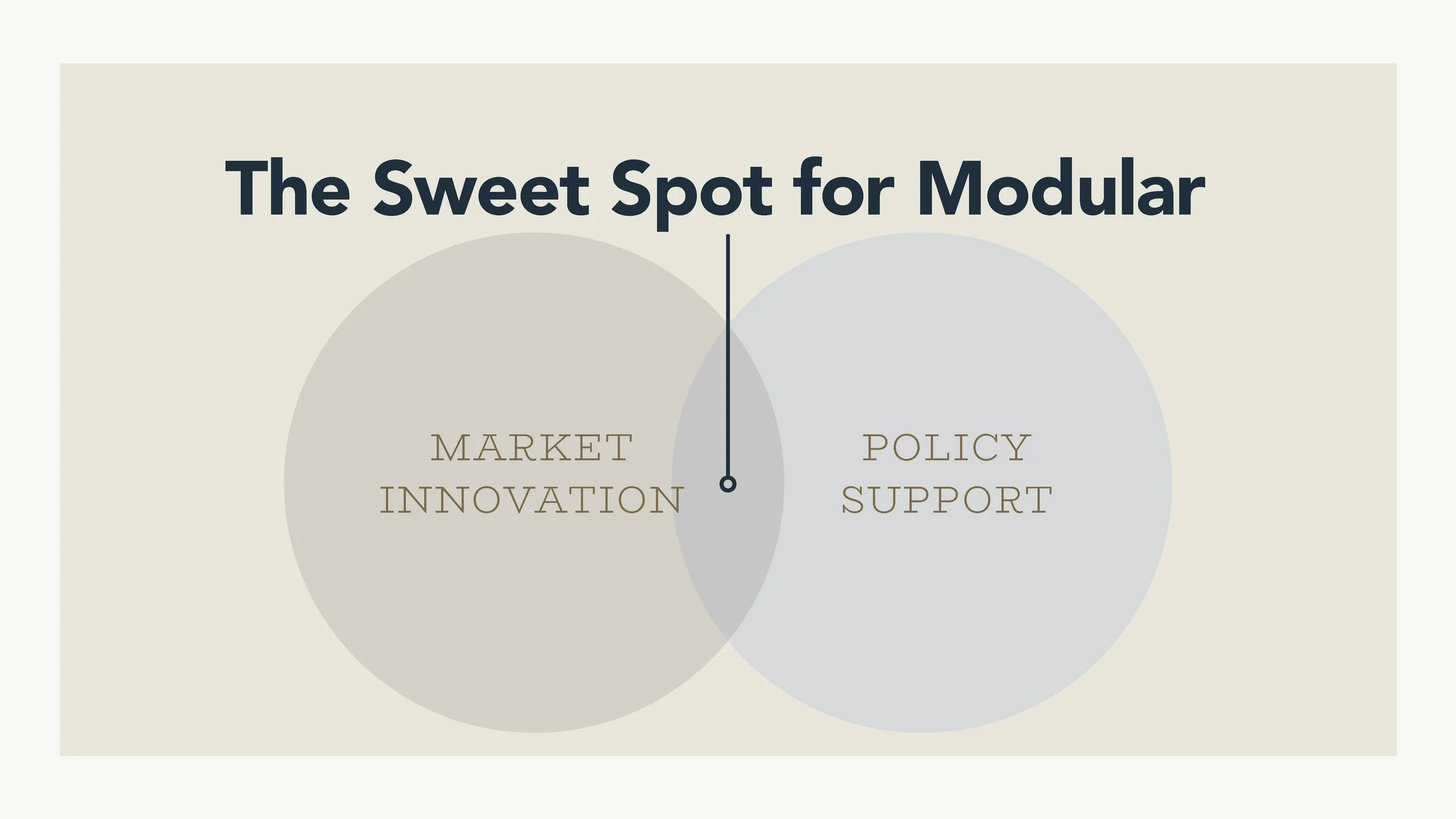
Modular isn’t Canada’s monorail; it’s our next great systems challenge. We already have the ingenuity, the talent, and the urgency. What’s needed now is alignment — between belief and process, policy and practice, ambition and discipline. If we can get that rhythm right, Canada won’t just build more homes; we’ll build a smarter way of housing people.
The difference between a headline and a housing system is method. We’re betting on process.
— DM